

.svg)


Go Back
The Cost of Sending Money Home - Global Remittance Report (Infographic)
By
Adeniyi

September 17, 2026
5
mins read



Every year, millions of migrants send money home to support their families, pay for essential needs and contribute to local economies. But while remittances provide an important financial lifeline, the cost of sending that money can affect how much recipients ultimately receive.
Pesa's Cost of Sending Money Home report looks at global remittance trends, where money is being sent from and received, and why keeping transfer costs low matters.
Key Takeaways
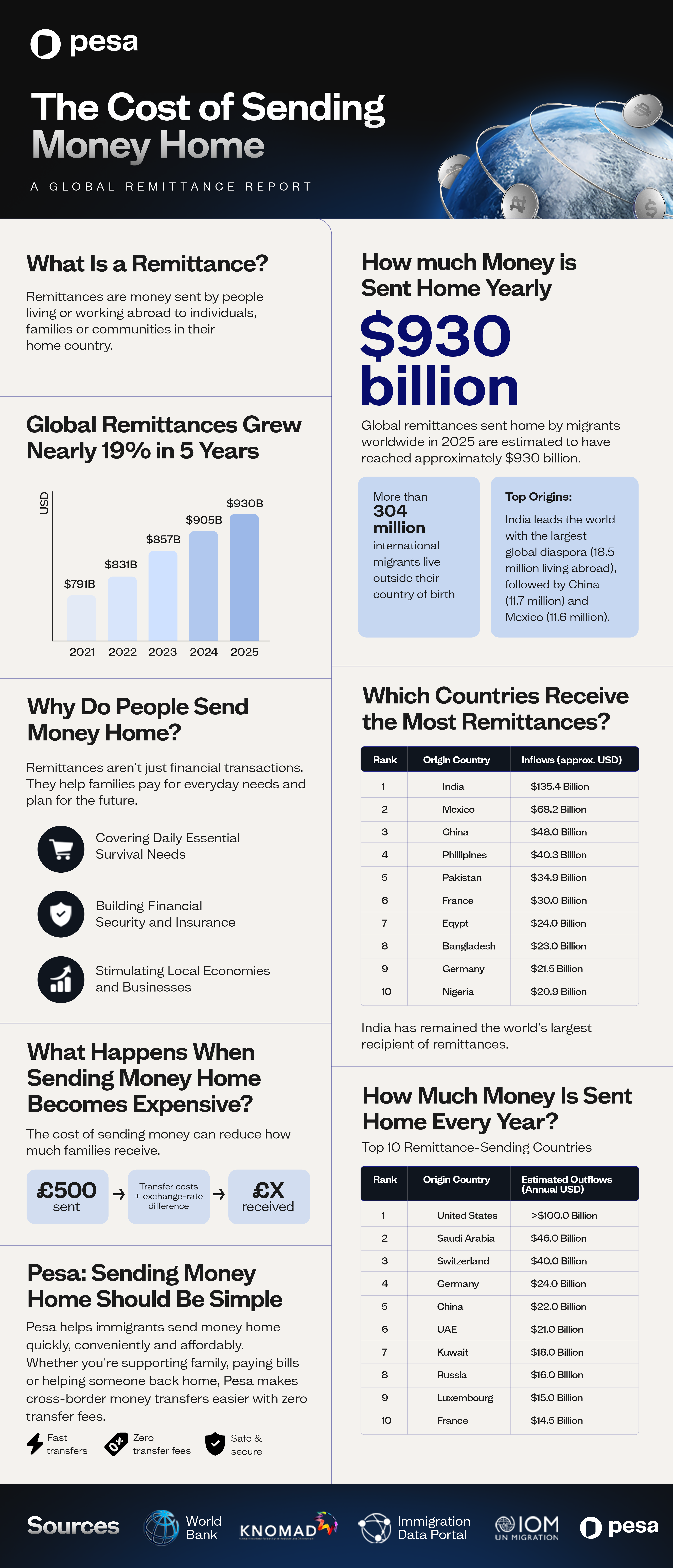
- Global remittances reached approximately $930 billion in 2025, up from $791 billion in 2021.
- More than 304 million international migrants live outside their country of birth.
- India received the most remittances, with approximately $135.4 billion in inflows.
- The United States is the world's largest source of remittances, with annual outflows exceeding $100 billion.
- Transfer costs matter: fees and exchange-rate markups can reduce the amount families receive back home.
- Remittances support more than day-to-day spending—they can contribute to financial security, insurance, local businesses and communities.
The Global Remittance Picture
Global remittances have continued to grow, reaching an estimated $930 billion in 2025, compared with $791 billion in 2021. This growth reflects the significant role migrants play in supporting families and communities across borders.
India was the largest recipient of remittances, receiving approximately $135.4 billion, followed by Mexico ($68.2 billion), China ($48.0 billion), the Philippines ($40.3 billion) and Pakistan ($34.9 billion).
On the sending side, the United States ranked first, with annual remittance outflows exceeding $100 billion. Saudi Arabia, Switzerland, Germany and China were also among the world's largest remittance-sending countries.
Why the Cost of Sending Money Matters
For many families, remittances help cover everyday necessities, build financial security and support local businesses. This makes the amount that actually reaches the recipient important.
When someone transfer money abroad, the recipient may receive less because of transfer fees and exchange-rate costs. Even seemingly small costs can add up over multiple transfers.
For example, if someone sends £500 but fees and exchange-rate differences reduce the amount received, the final amount available to the recipient could be significantly lower.
Keeping transfer costs transparent and competitive means more of the sender's money can reach the people who need it.
Summary
Remittances are a critical part of the global economy, with hundreds of billions of dollars sent home by migrants every year. As the volume of international money transfers continues to grow, the cost of sending that money matters more than ever.
For people supporting family and communities back home, choosing a transfer service with competitive exchange rates, transparent pricing and low fees can make a meaningful difference.
Pesa helps make sending money home simple, fast and affordable.

Related articles
See all



Think money
Think Pesa
From home to abroad, and everywhere in between. We’ll help you send, receive, and convert your money with ease.
Download the appDownload the app


Join thousands of users sending money
Scan the QR code below with your phone
and you’ll get a link to get started

