Text Link
Life on the Go
Text Link
Life on the Go

Understanding Australian Banking as a New Migrant: A Complete Guide

By 
Adeniyi
October 28, 2026

5

mins read 
Blog Thumbnail

Moving to Australia as a new migrant involves more than finding a place to live and securing a job. You also need to understand how to manage your money, receive your salary, pay bills and transfer funds between Australia and your home country.

Understanding Australian banking as a new migrant starts with opening an appropriate bank account, learning how everyday payments work and knowing how to manage your money safely. Once you understand these basics, it becomes easier to handle your finances and settle into life in Australia.

Australia has a well-established banking system, with traditional banks, digital banking services, credit unions and other financial institutions offering different products. However, account requirements, fees and eligibility can vary between providers. The Australian Government recommends that new arrivals compare banking options and understand the terms and conditions before opening an account.

This guide explains how Australian banking works, what you need to open an account, how to manage everyday payments and how to handle international money transfers as you settle into your new home.

‍

Key Takeaways

  • Open an Australian transaction account: You'll generally need one to receive your salary, pay bills and manage everyday expenses. Check your bank's identification requirements and account fees before applying.
  • Understand the main banking services: Transaction accounts, savings accounts, debit cards, bank transfers and digital banking each serve different purposes.
  • Plan for international money transfers: If you still have financial commitments in your home country, compare transfer fees, exchange rates and delivery times before moving money.
  • Build good financial habits early: Protect your banking details, create a budget, understand your tax obligations and compare financial products before committing.

‍

How Does the Australian Banking System Work?

Australia's banking system allows individuals and businesses to deposit money, make payments, save, borrow and manage their finances through financial institutions.

As a new migrant, you'll encounter several types of providers, including:

  • Major banks: Large institutions offering everyday accounts, savings accounts, cards, loans and other financial products.
  • Regional and smaller banks: Institutions that provide banking services to individuals and businesses, sometimes with a regional focus.
  • Digital banks and app-based financial services: Providers that let you manage some or all of your financial activities online.
  • Credit unions and mutual banks: Member-owned financial institutions offering various banking products.

The Australian Prudential Regulation Authority (APRA) supervises authorised deposit-taking institutions, including banks, building societies and credit unions. The Australian Securities and Investments Commission (ASIC) also regulates financial services and consumer protection matters within its remit.

When choosing a provider, check its regulatory status and understand how your money is held. Eligible deposits with Australian authorised deposit-taking institutions may be protected under the Australian Government's Financial Claims Scheme, subject to its conditions and limits.

You can check APRA's official register to confirm whether a financial institution is authorised.

                Send money with Pesa

Types of Bank Accounts in Australia

Before opening an account, understand the main types available and what each one is designed to do.

1. Transaction Accounts

A transaction account, sometimes called an everyday account, is designed for regular spending and receiving money.

You can generally use it to:

  • Receive your salary or wages.
  • Pay rent, utilities and other bills.
  • Make bank transfers.
  • Pay for groceries and transport.
  • Withdraw cash from ATMs.
  • Make online and in-store purchases using a linked debit card.

For most new migrants, opening a transaction account is one of the first steps towards managing everyday finances in Australia.

Compare monthly account fees, minimum deposit requirements, ATM charges and any conditions attached to the account.

2. Savings Accounts

A savings account is designed to help you set money aside while potentially earning interest.

You might use one to save for emergencies, future travel, education, a car or a house deposit.

When comparing savings accounts, look at:

  • The standard interest rate.
  • Any introductory or bonus interest rate.
  • Conditions for earning bonus interest.
  • Minimum balance or deposit requirements.
  • Withdrawal restrictions, if any.
  • Account fees.

Some savings accounts offer a higher interest rate only if you meet specific conditions, such as depositing a minimum amount or making regular deposits without withdrawing money.

Read the terms carefully before choosing an account.

3. Term Deposits

A term deposit allows you to deposit money for a fixed period at an agreed interest rate.

Depending on the product, you may choose a term ranging from a few months to several years.

Term deposits can suit people who have savings they do not expect to need immediately. However, early withdrawals may require notice or incur a reduced interest return or other costs.

Before opening one, check the maturity date, interest payment arrangements and early withdrawal conditions.

4. Credit Cards

A credit card allows you to borrow money from a financial institution up to an approved credit limit.

You can use it for purchases and repay the balance according to the card's terms.

However, credit cards can charge interest, annual fees and other costs. If you don't repay the outstanding balance by the required date, interest may accumulate.

New migrants may also find that eligibility depends on income, employment, residency circumstances, credit assessment and the provider's policies.

You don't need a credit card to manage your everyday banking in Australia. A transaction account and debit card may be sufficient when you're starting out.

‍

                Download the Pesa app

‍

How to Open a Bank Account in Australia as a Migrant

Opening an Australian bank account can often be done online or at a branch, depending on the provider and your circumstances.

Some banks allow eligible customers to begin an application before arriving in Australia. Others require you to be in the country or complete identity verification in person.

Step 1: Choose a bank or financial institution

Compare several providers rather than selecting the first account you find.

Consider account fees, digital banking features, branch access, customer support, savings options and international transfer costs.

Step 2: Check the identification requirements

Banks must verify customers' identities under applicable laws and regulations.

Depending on the institution and your circumstances, you may be asked for:

  • A valid passport.
  • Visa or immigration details.
  • An Australian residential address.
  • An Australian or international mobile number.
  • Additional identity documents.
  • Tax residency information and a foreign tax identification number, where applicable.

The documents required can differ between providers and application methods. Check the bank's current identification checklist before applying.

Step 3: Submit your application

Complete the application through the bank's official website or app, or visit a branch if required.

Enter your personal details accurately and provide any requested documentation.

Step 4: Verify your identity

Follow the bank's instructions for identity verification. You may be able to complete this online, or you may need to visit a branch.

Step 5: Activate your account

Once your application has been approved and any required verification is complete, follow the instructions to activate your account and set up online banking.

If a debit card is included, check whether it is available digitally before the physical card arrives.

‍

When should you open an account?

It's worth researching your options before arriving in Australia if you can. Some banks offer eligible newcomers the option to start an application shortly before their arrival.

The Australian Government's settlement guidance has historically advised new arrivals to open a bank account within six weeks of arriving, when a simplified identification process may apply. However, requirements can vary, so confirm the current rules with your chosen bank rather than relying on the six-week period as a universal guarantee.

‍

What Is a BSB Number, and Why Do You Need One?

One of the first banking terms you'll encounter in Australia is BSB number.

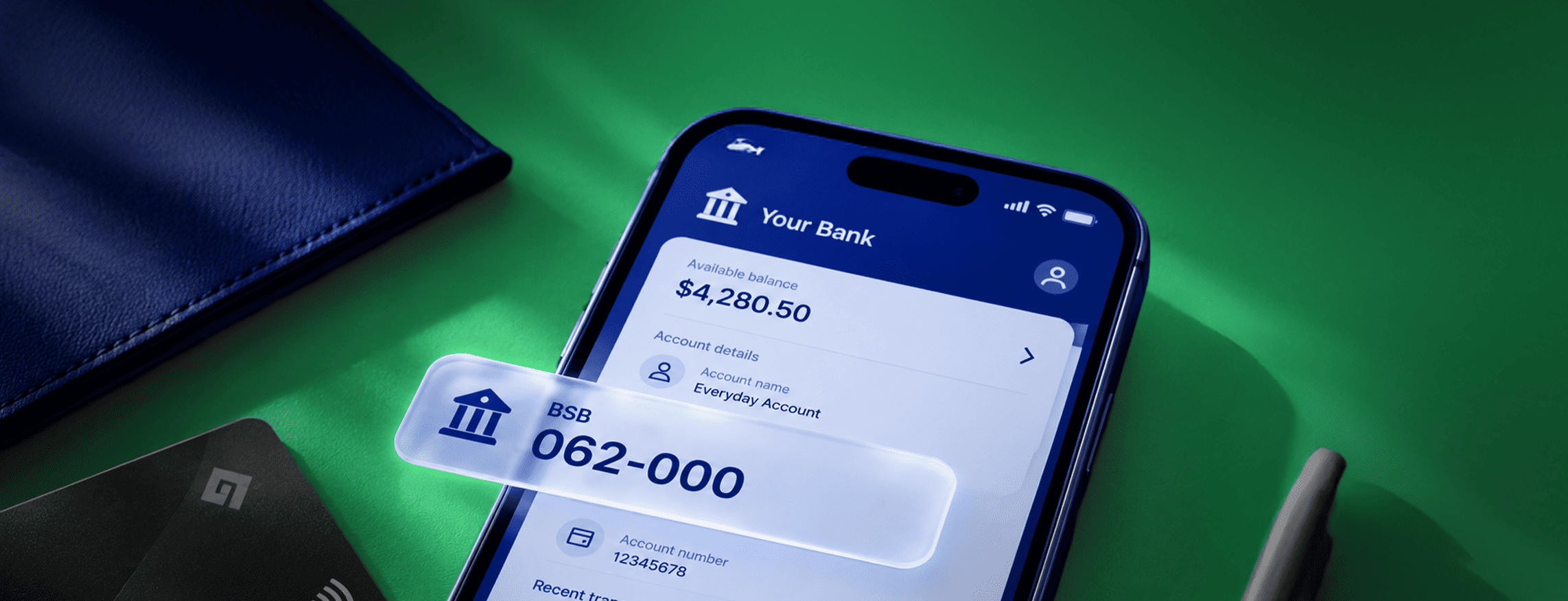
BSB stands for Bank State Branch. It is a six-digit identifier used to route payments to an Australian bank or branch or processing location.

A BSB is usually written in this format: XXX-XXX.

You'll generally need your BSB and account number to receive a domestic bank transfer into an Australian bank account.

For example, when starting a new job, your employer may ask for your bank account details so they can deposit your salary.

Your BSB and account number serve different purposes:

  • BSB: Identifies the relevant Australian bank or processing location.
  • Account number: Identifies your individual account.

You can usually find both in your bank's mobile app, online banking or account statement.

If someone overseas wants to send money to your Australian bank account, they may also need your bank's SWIFT/BIC code and other information, depending on the transfer method.

‍

How Do Payments Work in Australia?

Australia has a range of payment methods, and you'll probably use several of them in your everyday life.

1: Debit Cards

A debit card lets you spend money from your linked bank account.

You can use it to pay for groceries, transport, shopping and online purchases. Many debit cards support contactless payments and digital wallets.

Unlike a credit card, a debit card generally uses money already available in your account rather than a credit facility.

2: PayID

PayID allows people to send and receive payments using an eligible identifier, such as a mobile number, email address or Australian Business Number, linked to a participating bank account.

It can make payments easier because you don't always need to exchange BSB and account number details.

Before confirming a payment, check the recipient information displayed by your banking app.

3: Osko and Fast Payments

Osko and the New Payments Platform (NPP) support fast payments between participating Australian financial institutions.

Eligible payments may arrive within seconds, including outside normal banking hours. However, timing depends on the participating institutions, payment type and any security checks.

Don't assume every bank transfer is instant. Some payments still take longer to process.

4: BPAY

BPAY is a payment system used by many Australian billers.

You can use it to pay certain bills through your online banking or mobile banking app using the biller's code and your customer reference number.

5: Direct Debits and Automatic Payments

You can arrange automatic payments for recurring expenses such as utilities, subscriptions and some rent arrangements.

Before setting up an automatic payment, check the amount, frequency and cancellation process. Keep enough money in your account to cover scheduled payments and avoid potential dishonour fees.

‍

Understanding Australian Banking Fees

Banking fees can reduce the money you have available for everyday expenses, particularly when you're still adjusting to the cost of living.

Common fees include:

Fee type What it means
Monthly account fee A recurring charge for maintaining an account.
ATM fee A charge for certain cash withdrawals.
International transfer fee A fee for sending money overseas.
Foreign currency conversion fee A fee that may apply when converting or spending in another currency.
Overdraft fee or interest Costs that may apply if you spend beyond your available balance under an overdraft arrangement.
Card replacement fee A possible charge for replacing a card in certain circumstances.

‍

A possible charge for replacing a card in certain circumstances

Not every bank charges all these fees, and some accounts waive fees when you meet specific conditions.

Before opening an account, ask yourself:

  • Is there a monthly fee?
  • Can the fee be waived?
  • Are there charges for ATM withdrawals?
  • What happens when I use my card overseas?
  • How much does an international transfer cost?
  • Are there fees for receiving overseas payments?

If you expect to send money to family or maintain financial commitments in another country, pay particular attention to international transfer costs and exchange rates.

‍

How to Manage Money as a New Migrant in Australia

Opening a bank account is only the beginning. You also need a system for managing income, expenses and savings.

1: Create a Budget

Start by estimating your regular income and essential expenses.

Your budget might include:

  • Rent and utilities.
  • Groceries.
  • Public transport or car expenses.
  • Mobile phone and internet.
  • Health and other insurance.
  • Education and childcare.
  • Money sent to family overseas.
  • Savings and emergency expenses.

Australian living costs vary significantly by city, household size and lifestyle. Track your actual spending during the first few months so you can adjust your budget to reflect your circumstances.

2: Set Up Separate Savings

If your account setup allows it, consider keeping your everyday spending money separate from your savings.

For example, you could use a transaction account for bills and daily expenses and a savings account for emergencies.

Choose an arrangement that helps you understand how much money is available to spend without dipping into funds set aside for future needs.

3: Understand Your Tax File Number

A Tax File Number (TFN) is a personal reference number used by the Australian Taxation Office (ATO) to administer the tax system.

You may need a TFN for employment and other tax-related purposes.

If you start working, provide your TFN to your employer when appropriate. Without it, you may have more tax withheld from your pay than necessary, depending on your circumstances.

A TFN is different from a bank account number and should be handled securely.

You can find information about applying for a TFN through the official ATO website.

4: Keep Track of Your Bills

Set reminders for rent, utilities, insurance and other recurring expenses.

You can also use your bank's app to review transactions, monitor balances and set up eligible automatic payments.

Checking your account regularly helps you spot unexpected charges and identify spending patterns before they become difficult to manage.

‍

Sending Money Overseas From Australia

Many migrants continue to support family members, pay expenses or maintain financial commitments in their home country.

You might need to send money to relatives, pay an overseas bill or transfer funds between your own accounts.

Your Australian bank may offer international transfers, but the total cost can include transfer fees, exchange-rate margins and charges from intermediary or receiving institutions.

Before making a transfer, compare:

  1. Transfer fee: What the provider charges to process the payment.
  2. Exchange rate: How much foreign currency you receive for each Australian dollar.
  3. Delivery time: When the recipient can expect the money.
  4. Receiving method: Whether the funds arrive in a bank account, wallet or another supported destination.

A provider advertising a zero transfer fee isn't automatically the cheapest option. The exchange rate also affects the final amount received.

‍

Using Pesa for International Money Transfers

At Pesa, we help customers manage cross-border money transfers through supported currencies and destinations.

You can use Pesa to send money internationally, convert between supported currencies and manage your money through the app. Our international money transfer service supports transfers to multiple destinations, with availability depending on the currency and route.

Pesa offers $0 transfer fees on supported transfers, and you can review the applicable exchange rate and transaction details before confirming a payment. Always check the live quote, as rates and promotional terms can change.

Pesa may be useful if you have recently moved to Australia but still need to move money between countries. Rather than treating your Australian banking and international transfers as completely separate tasks, you can compare the options available for your cross-border needs.

Before making your first transfer, check the supported destination, payment method, recipient details and expected delivery time.

‍

‍

How to Choose the Right Financial Services as a New Migrant

You don't need to sign up for every financial product as soon as you arrive. Start with the services that support your immediate needs, then add others as your circumstances change.

A: For Everyday Banking

Look for a transaction account with convenient access, reasonable fees and the features you need to receive income and pay bills.

B: For Saving Money

Compare savings accounts based on their interest rates, eligibility requirements and conditions for earning bonus interest.

C: For International Transfers

Compare your bank's international transfer service with specialist providers such as Pesa. Focus on the total cost, exchange rate, delivery time and receiving method.

D: For Business or Freelance Income

If you work for international clients or run a business, check whether you need multi-currency receiving options, business accounts or additional payment services.

Personal and business accounts may have different eligibility requirements and fees.

E: For Borrowing

Credit cards, personal loans and home loans involve different eligibility criteria, interest rates and risks.

If you're new to Australia, check whether the provider accepts your residency and employment circumstances. Avoid borrowing until you understand the repayment obligations and the total cost of the credit.

‍

Common Banking Mistakes New Migrants Should Avoid

Understanding a few common pitfalls can make the transition to Australian banking easier.

1: Choosing an account without checking its fees. An account that appears convenient may charge monthly or transaction fees that could be avoided with a different product.

2: Assuming every international transfer costs the same. Providers use different pricing structures and exchange rates. Compare the amount the recipient actually receives.

3: Confusing a BSB with a SWIFT code. A BSB is used for Australian banking payments, while a SWIFT/BIC identifies a financial institution for international payments.

4: Sharing sensitive banking information. Never share your password, PIN or one-time authentication codes with someone who claims they need them to send you money.

5: Ignoring tax responsibilities. Understand your obligations as an Australian resident for tax purposes and seek official guidance if your situation involves income or assets overseas.

6: Taking on credit too quickly. Understand the interest rate, fees and repayment conditions before accepting a credit card or loan.

7: Failing to budget for irregular expenses. Moving costs, medical expenses, transport repairs and other unexpected payments can place pressure on a new household budget.

‍

Frequently Asked Questions

1: Can I open an Australian bank account before arriving in Australia?

Some Australian banks allow eligible migrants to begin opening an account before arrival, often within a specified period before their travel date. You may still need to verify your identity after arriving. Check the bank's current eligibility and identification requirements.

2: Do I need an Australian address to open a bank account?

Requirements vary between banks and account types. Some providers ask for an Australian residential address, which may be a temporary address in eligible circumstances. Confirm the requirements with the provider before applying.

3: Can I receive my salary without an Australian bank account?

Payment arrangements depend on your employer, but an Australian bank account is commonly used to receive wages. Opening one can also make it easier to pay rent, bills and other everyday expenses.

4: Will opening a bank account automatically give me a credit history in Australia?

No. A transaction account does not automatically establish a positive credit history. Australian credit reports are influenced by information reported by credit providers and other eligible sources. If you want to build a credit history, understand how credit products work before applying for them.

5: Can I keep using my bank account from my home country after moving to Australia?

Possibly. This depends on your existing bank's rules, your residency and tax circumstances, and the services available to customers living overseas. Contact your existing bank before moving to confirm whether you can keep the account open and how to access it from Australia.

‍

Final Thoughts: Take Control of Your Finances in Australia

Understanding Australian banking as a new migrant is an important step towards building a stable financial life in your new country.

Start by opening a suitable transaction account, learning how BSBs and everyday payment methods work, and understanding the fees attached to your banking services. Then create a budget, organise your bills and familiarise yourself with your Australian tax responsibilities.

If you still need to support family overseas or manage money across borders, compare international transfer providers before sending your first payment. Look beyond the advertised fee and check the exchange rate, delivery time and final amount received.

Your next step: shortlist two or three banking providers, compare their account terms and identification requirements, and open an account that fits your immediate needs. International transfers are part of everyday financial life, so explore Pesa's supported destinations and currencies alongside your everyday Australian banking options.

The goal isn't to make your finances more complicated. It's to build a simple system that helps you receive money, pay expenses, save consistently and stay connected financially to the people and commitments that matter to you.

                Send money with Pesa

Adeniyi

Related articles

See all
Adeniyi
Ibukun
Felix
Oge
Tolu Osho

Ready to
Experience Pesa?

Think money
‍Think Pesa

From home to abroad, and everywhere in between. We’ll help you send, receive, and convert your money with ease.

Download the appDownload the app

© 2026 Pesa LLC. All rights reserved.

Pesapeer Inc, is registered and regularised in Canada by the Financial Transactions and Report Analysis Centre of Canada as a Money Service Business. Rn: M20300281.

Pesapeer Payments LLC ((NMLS number 2796311) is registered in the United States as a Money Service Business with the United States Financial Crimes Enforcement Network (FinCEN). Rn: 31000315905794.

Pesapeer Payments Limited. Authorised and regulated by the Financial Conduct Authority (FCA) as Electronic Money Institution under Firm Reference Number (FRN) 931425. Registered address: Milton Hall Ely Road, Milton, Cambridge, England, CB24 6WZC UNITED KINGDOM.

Pesapeer Pty Ltd is also registered and regularised in Australia by the Australian Transaction Reports and Analysis Centre as an Independent Remittance Dealer  Rn: IND100859468-001

Back

Understanding Australian Banking as a New Migrant: A Complete Guide

By
Adeniyi
.
October 28, 2026
.
5
mins read
Life on the Go

Moving to Australia as a new migrant involves more than finding a place to live and securing a job. You also need to understand how to manage your money, receive your salary, pay bills and transfer funds between Australia and your home country.

Understanding Australian banking as a new migrant starts with opening an appropriate bank account, learning how everyday payments work and knowing how to manage your money safely. Once you understand these basics, it becomes easier to handle your finances and settle into life in Australia.

Australia has a well-established banking system, with traditional banks, digital banking services, credit unions and other financial institutions offering different products. However, account requirements, fees and eligibility can vary between providers. The Australian Government recommends that new arrivals compare banking options and understand the terms and conditions before opening an account.

This guide explains how Australian banking works, what you need to open an account, how to manage everyday payments and how to handle international money transfers as you settle into your new home.

‍

Key Takeaways

  • Open an Australian transaction account: You'll generally need one to receive your salary, pay bills and manage everyday expenses. Check your bank's identification requirements and account fees before applying.
  • Understand the main banking services: Transaction accounts, savings accounts, debit cards, bank transfers and digital banking each serve different purposes.
  • Plan for international money transfers: If you still have financial commitments in your home country, compare transfer fees, exchange rates and delivery times before moving money.
  • Build good financial habits early: Protect your banking details, create a budget, understand your tax obligations and compare financial products before committing.

‍

How Does the Australian Banking System Work?

Australia's banking system allows individuals and businesses to deposit money, make payments, save, borrow and manage their finances through financial institutions.

As a new migrant, you'll encounter several types of providers, including:

  • Major banks: Large institutions offering everyday accounts, savings accounts, cards, loans and other financial products.
  • Regional and smaller banks: Institutions that provide banking services to individuals and businesses, sometimes with a regional focus.
  • Digital banks and app-based financial services: Providers that let you manage some or all of your financial activities online.
  • Credit unions and mutual banks: Member-owned financial institutions offering various banking products.

The Australian Prudential Regulation Authority (APRA) supervises authorised deposit-taking institutions, including banks, building societies and credit unions. The Australian Securities and Investments Commission (ASIC) also regulates financial services and consumer protection matters within its remit.

When choosing a provider, check its regulatory status and understand how your money is held. Eligible deposits with Australian authorised deposit-taking institutions may be protected under the Australian Government's Financial Claims Scheme, subject to its conditions and limits.

You can check APRA's official register to confirm whether a financial institution is authorised.

                Send money with Pesa

Types of Bank Accounts in Australia

Before opening an account, understand the main types available and what each one is designed to do.

1. Transaction Accounts

A transaction account, sometimes called an everyday account, is designed for regular spending and receiving money.

You can generally use it to:

  • Receive your salary or wages.
  • Pay rent, utilities and other bills.
  • Make bank transfers.
  • Pay for groceries and transport.
  • Withdraw cash from ATMs.
  • Make online and in-store purchases using a linked debit card.

For most new migrants, opening a transaction account is one of the first steps towards managing everyday finances in Australia.

Compare monthly account fees, minimum deposit requirements, ATM charges and any conditions attached to the account.

2. Savings Accounts

A savings account is designed to help you set money aside while potentially earning interest.

You might use one to save for emergencies, future travel, education, a car or a house deposit.

When comparing savings accounts, look at:

  • The standard interest rate.
  • Any introductory or bonus interest rate.
  • Conditions for earning bonus interest.
  • Minimum balance or deposit requirements.
  • Withdrawal restrictions, if any.
  • Account fees.

Some savings accounts offer a higher interest rate only if you meet specific conditions, such as depositing a minimum amount or making regular deposits without withdrawing money.

Read the terms carefully before choosing an account.

3. Term Deposits

A term deposit allows you to deposit money for a fixed period at an agreed interest rate.

Depending on the product, you may choose a term ranging from a few months to several years.

Term deposits can suit people who have savings they do not expect to need immediately. However, early withdrawals may require notice or incur a reduced interest return or other costs.

Before opening one, check the maturity date, interest payment arrangements and early withdrawal conditions.

4. Credit Cards

A credit card allows you to borrow money from a financial institution up to an approved credit limit.

You can use it for purchases and repay the balance according to the card's terms.

However, credit cards can charge interest, annual fees and other costs. If you don't repay the outstanding balance by the required date, interest may accumulate.

New migrants may also find that eligibility depends on income, employment, residency circumstances, credit assessment and the provider's policies.

You don't need a credit card to manage your everyday banking in Australia. A transaction account and debit card may be sufficient when you're starting out.

‍

                Download the Pesa app

‍

How to Open a Bank Account in Australia as a Migrant

Opening an Australian bank account can often be done online or at a branch, depending on the provider and your circumstances.

Some banks allow eligible customers to begin an application before arriving in Australia. Others require you to be in the country or complete identity verification in person.

Step 1: Choose a bank or financial institution

Compare several providers rather than selecting the first account you find.

Consider account fees, digital banking features, branch access, customer support, savings options and international transfer costs.

Step 2: Check the identification requirements

Banks must verify customers' identities under applicable laws and regulations.

Depending on the institution and your circumstances, you may be asked for:

  • A valid passport.
  • Visa or immigration details.
  • An Australian residential address.
  • An Australian or international mobile number.
  • Additional identity documents.
  • Tax residency information and a foreign tax identification number, where applicable.

The documents required can differ between providers and application methods. Check the bank's current identification checklist before applying.

Step 3: Submit your application

Complete the application through the bank's official website or app, or visit a branch if required.

Enter your personal details accurately and provide any requested documentation.

Step 4: Verify your identity

Follow the bank's instructions for identity verification. You may be able to complete this online, or you may need to visit a branch.

Step 5: Activate your account

Once your application has been approved and any required verification is complete, follow the instructions to activate your account and set up online banking.

If a debit card is included, check whether it is available digitally before the physical card arrives.

‍

When should you open an account?

It's worth researching your options before arriving in Australia if you can. Some banks offer eligible newcomers the option to start an application shortly before their arrival.

The Australian Government's settlement guidance has historically advised new arrivals to open a bank account within six weeks of arriving, when a simplified identification process may apply. However, requirements can vary, so confirm the current rules with your chosen bank rather than relying on the six-week period as a universal guarantee.

‍

What Is a BSB Number, and Why Do You Need One?

One of the first banking terms you'll encounter in Australia is BSB number.

BSB stands for Bank State Branch. It is a six-digit identifier used to route payments to an Australian bank or branch or processing location.

A BSB is usually written in this format: XXX-XXX.

You'll generally need your BSB and account number to receive a domestic bank transfer into an Australian bank account.

For example, when starting a new job, your employer may ask for your bank account details so they can deposit your salary.

Your BSB and account number serve different purposes:

  • BSB: Identifies the relevant Australian bank or processing location.
  • Account number: Identifies your individual account.

You can usually find both in your bank's mobile app, online banking or account statement.

If someone overseas wants to send money to your Australian bank account, they may also need your bank's SWIFT/BIC code and other information, depending on the transfer method.

‍

How Do Payments Work in Australia?

Australia has a range of payment methods, and you'll probably use several of them in your everyday life.

1: Debit Cards

A debit card lets you spend money from your linked bank account.

You can use it to pay for groceries, transport, shopping and online purchases. Many debit cards support contactless payments and digital wallets.

Unlike a credit card, a debit card generally uses money already available in your account rather than a credit facility.

2: PayID

PayID allows people to send and receive payments using an eligible identifier, such as a mobile number, email address or Australian Business Number, linked to a participating bank account.

It can make payments easier because you don't always need to exchange BSB and account number details.

Before confirming a payment, check the recipient information displayed by your banking app.

3: Osko and Fast Payments

Osko and the New Payments Platform (NPP) support fast payments between participating Australian financial institutions.

Eligible payments may arrive within seconds, including outside normal banking hours. However, timing depends on the participating institutions, payment type and any security checks.

Don't assume every bank transfer is instant. Some payments still take longer to process.

4: BPAY

BPAY is a payment system used by many Australian billers.

You can use it to pay certain bills through your online banking or mobile banking app using the biller's code and your customer reference number.

5: Direct Debits and Automatic Payments

You can arrange automatic payments for recurring expenses such as utilities, subscriptions and some rent arrangements.

Before setting up an automatic payment, check the amount, frequency and cancellation process. Keep enough money in your account to cover scheduled payments and avoid potential dishonour fees.

‍

Understanding Australian Banking Fees

Banking fees can reduce the money you have available for everyday expenses, particularly when you're still adjusting to the cost of living.

Common fees include:

Fee type What it means
Monthly account fee A recurring charge for maintaining an account.
ATM fee A charge for certain cash withdrawals.
International transfer fee A fee for sending money overseas.
Foreign currency conversion fee A fee that may apply when converting or spending in another currency.
Overdraft fee or interest Costs that may apply if you spend beyond your available balance under an overdraft arrangement.
Card replacement fee A possible charge for replacing a card in certain circumstances.

‍

A possible charge for replacing a card in certain circumstances

Not every bank charges all these fees, and some accounts waive fees when you meet specific conditions.

Before opening an account, ask yourself:

  • Is there a monthly fee?
  • Can the fee be waived?
  • Are there charges for ATM withdrawals?
  • What happens when I use my card overseas?
  • How much does an international transfer cost?
  • Are there fees for receiving overseas payments?

If you expect to send money to family or maintain financial commitments in another country, pay particular attention to international transfer costs and exchange rates.

‍

How to Manage Money as a New Migrant in Australia

Opening a bank account is only the beginning. You also need a system for managing income, expenses and savings.

1: Create a Budget

Start by estimating your regular income and essential expenses.

Your budget might include:

  • Rent and utilities.
  • Groceries.
  • Public transport or car expenses.
  • Mobile phone and internet.
  • Health and other insurance.
  • Education and childcare.
  • Money sent to family overseas.
  • Savings and emergency expenses.

Australian living costs vary significantly by city, household size and lifestyle. Track your actual spending during the first few months so you can adjust your budget to reflect your circumstances.

2: Set Up Separate Savings

If your account setup allows it, consider keeping your everyday spending money separate from your savings.

For example, you could use a transaction account for bills and daily expenses and a savings account for emergencies.

Choose an arrangement that helps you understand how much money is available to spend without dipping into funds set aside for future needs.

3: Understand Your Tax File Number

A Tax File Number (TFN) is a personal reference number used by the Australian Taxation Office (ATO) to administer the tax system.

You may need a TFN for employment and other tax-related purposes.

If you start working, provide your TFN to your employer when appropriate. Without it, you may have more tax withheld from your pay than necessary, depending on your circumstances.

A TFN is different from a bank account number and should be handled securely.

You can find information about applying for a TFN through the official ATO website.

4: Keep Track of Your Bills

Set reminders for rent, utilities, insurance and other recurring expenses.

You can also use your bank's app to review transactions, monitor balances and set up eligible automatic payments.

Checking your account regularly helps you spot unexpected charges and identify spending patterns before they become difficult to manage.

‍

Sending Money Overseas From Australia

Many migrants continue to support family members, pay expenses or maintain financial commitments in their home country.

You might need to send money to relatives, pay an overseas bill or transfer funds between your own accounts.

Your Australian bank may offer international transfers, but the total cost can include transfer fees, exchange-rate margins and charges from intermediary or receiving institutions.

Before making a transfer, compare:

  1. Transfer fee: What the provider charges to process the payment.
  2. Exchange rate: How much foreign currency you receive for each Australian dollar.
  3. Delivery time: When the recipient can expect the money.
  4. Receiving method: Whether the funds arrive in a bank account, wallet or another supported destination.

A provider advertising a zero transfer fee isn't automatically the cheapest option. The exchange rate also affects the final amount received.

‍

Using Pesa for International Money Transfers

At Pesa, we help customers manage cross-border money transfers through supported currencies and destinations.

You can use Pesa to send money internationally, convert between supported currencies and manage your money through the app. Our international money transfer service supports transfers to multiple destinations, with availability depending on the currency and route.

Pesa offers $0 transfer fees on supported transfers, and you can review the applicable exchange rate and transaction details before confirming a payment. Always check the live quote, as rates and promotional terms can change.

Pesa may be useful if you have recently moved to Australia but still need to move money between countries. Rather than treating your Australian banking and international transfers as completely separate tasks, you can compare the options available for your cross-border needs.

Before making your first transfer, check the supported destination, payment method, recipient details and expected delivery time.

‍

‍

How to Choose the Right Financial Services as a New Migrant

You don't need to sign up for every financial product as soon as you arrive. Start with the services that support your immediate needs, then add others as your circumstances change.

A: For Everyday Banking

Look for a transaction account with convenient access, reasonable fees and the features you need to receive income and pay bills.

B: For Saving Money

Compare savings accounts based on their interest rates, eligibility requirements and conditions for earning bonus interest.

C: For International Transfers

Compare your bank's international transfer service with specialist providers such as Pesa. Focus on the total cost, exchange rate, delivery time and receiving method.

D: For Business or Freelance Income

If you work for international clients or run a business, check whether you need multi-currency receiving options, business accounts or additional payment services.

Personal and business accounts may have different eligibility requirements and fees.

E: For Borrowing

Credit cards, personal loans and home loans involve different eligibility criteria, interest rates and risks.

If you're new to Australia, check whether the provider accepts your residency and employment circumstances. Avoid borrowing until you understand the repayment obligations and the total cost of the credit.

‍

Common Banking Mistakes New Migrants Should Avoid

Understanding a few common pitfalls can make the transition to Australian banking easier.

1: Choosing an account without checking its fees. An account that appears convenient may charge monthly or transaction fees that could be avoided with a different product.

2: Assuming every international transfer costs the same. Providers use different pricing structures and exchange rates. Compare the amount the recipient actually receives.

3: Confusing a BSB with a SWIFT code. A BSB is used for Australian banking payments, while a SWIFT/BIC identifies a financial institution for international payments.

4: Sharing sensitive banking information. Never share your password, PIN or one-time authentication codes with someone who claims they need them to send you money.

5: Ignoring tax responsibilities. Understand your obligations as an Australian resident for tax purposes and seek official guidance if your situation involves income or assets overseas.

6: Taking on credit too quickly. Understand the interest rate, fees and repayment conditions before accepting a credit card or loan.

7: Failing to budget for irregular expenses. Moving costs, medical expenses, transport repairs and other unexpected payments can place pressure on a new household budget.

‍

Frequently Asked Questions

1: Can I open an Australian bank account before arriving in Australia?

Some Australian banks allow eligible migrants to begin opening an account before arrival, often within a specified period before their travel date. You may still need to verify your identity after arriving. Check the bank's current eligibility and identification requirements.

2: Do I need an Australian address to open a bank account?

Requirements vary between banks and account types. Some providers ask for an Australian residential address, which may be a temporary address in eligible circumstances. Confirm the requirements with the provider before applying.

3: Can I receive my salary without an Australian bank account?

Payment arrangements depend on your employer, but an Australian bank account is commonly used to receive wages. Opening one can also make it easier to pay rent, bills and other everyday expenses.

4: Will opening a bank account automatically give me a credit history in Australia?

No. A transaction account does not automatically establish a positive credit history. Australian credit reports are influenced by information reported by credit providers and other eligible sources. If you want to build a credit history, understand how credit products work before applying for them.

5: Can I keep using my bank account from my home country after moving to Australia?

Possibly. This depends on your existing bank's rules, your residency and tax circumstances, and the services available to customers living overseas. Contact your existing bank before moving to confirm whether you can keep the account open and how to access it from Australia.

‍

Final Thoughts: Take Control of Your Finances in Australia

Understanding Australian banking as a new migrant is an important step towards building a stable financial life in your new country.

Start by opening a suitable transaction account, learning how BSBs and everyday payment methods work, and understanding the fees attached to your banking services. Then create a budget, organise your bills and familiarise yourself with your Australian tax responsibilities.

If you still need to support family overseas or manage money across borders, compare international transfer providers before sending your first payment. Look beyond the advertised fee and check the exchange rate, delivery time and final amount received.

Your next step: shortlist two or three banking providers, compare their account terms and identification requirements, and open an account that fits your immediate needs. International transfers are part of everyday financial life, so explore Pesa's supported destinations and currencies alongside your everyday Australian banking options.

The goal isn't to make your finances more complicated. It's to build a simple system that helps you receive money, pay expenses, save consistently and stay connected financially to the people and commitments that matter to you.

                Send money with Pesa

Think Money

Think Pesa

Send, spend, save and do more with Pesa
— simply and freely.
Download the app
Download the app