Text Link
Money Matters
Text Link
Money Matters

What Is a Routing Number? Everything You Need to Know

By 
Adeniyi
November 25, 2026

3

mins read 
Blog Thumbnail

A routing number is a nine-digit code used to identify a bank or financial institution in the United States. It helps banks and payment networks direct money to the correct financial institution when processing transactions such as direct deposits, electronic payments, wire transfers and cheque payments.

You may be asked for a routing number when receiving money from a US bank account, setting up an automatic bill payment or arranging a domestic bank transfer. It is usually provided alongside your bank account number, which identifies your specific account.

Routing numbers are also known as ABA routing numbers or routing transit numbers (RTNs). Although they serve a similar purpose to bank identification codes in other countries, they are specific to the US banking system.

In this guide, we'll explain what a routing number is, how it works, where to find yours and when you need one for domestic or international transfers.

Key Takeaways

  • A US bank routing number is a nine-digit code that identifies a financial institution.
  • It is also called an ABA routing number or routing transit number (RTN).
  • Routing numbers are used for ACH payments, direct deposits, domestic wire transfers and cheque processing.
  • You can find your routing number on a cheque, in your bank's mobile app or through online banking.
  • Some banks have different routing numbers for ACH payments and wire transfers, so always confirm which one you need.

‍

What Is a Bank Routing Number?

A bank routing number is a unique nine-digit identifier assigned to an eligible financial institution in the United States. It helps payment networks identify the bank responsible for sending or receiving a payment.

The system was introduced by the American Bankers Association (ABA) in 1910 to make cheque processing more efficient. Although it was originally developed for paper cheques, routing numbers are now used for various electronic payment services.

For example, if an employer in the United States wants to pay an employee through direct deposit, the employee may need to provide their bank's routing number and personal account number.

The routing number identifies the bank, while the account number identifies the employee's specific account within that bank.

A routing number is therefore an important part of US banking transactions. Without the correct number, a payment may be delayed, rejected or sent to the wrong financial institution.

‍

                Download the Pesa app

‍

What Does a Routing Number Look Like?

A standard US routing number contains nine digits. Each digit has a specific role in identifying the financial institution and validating the number.

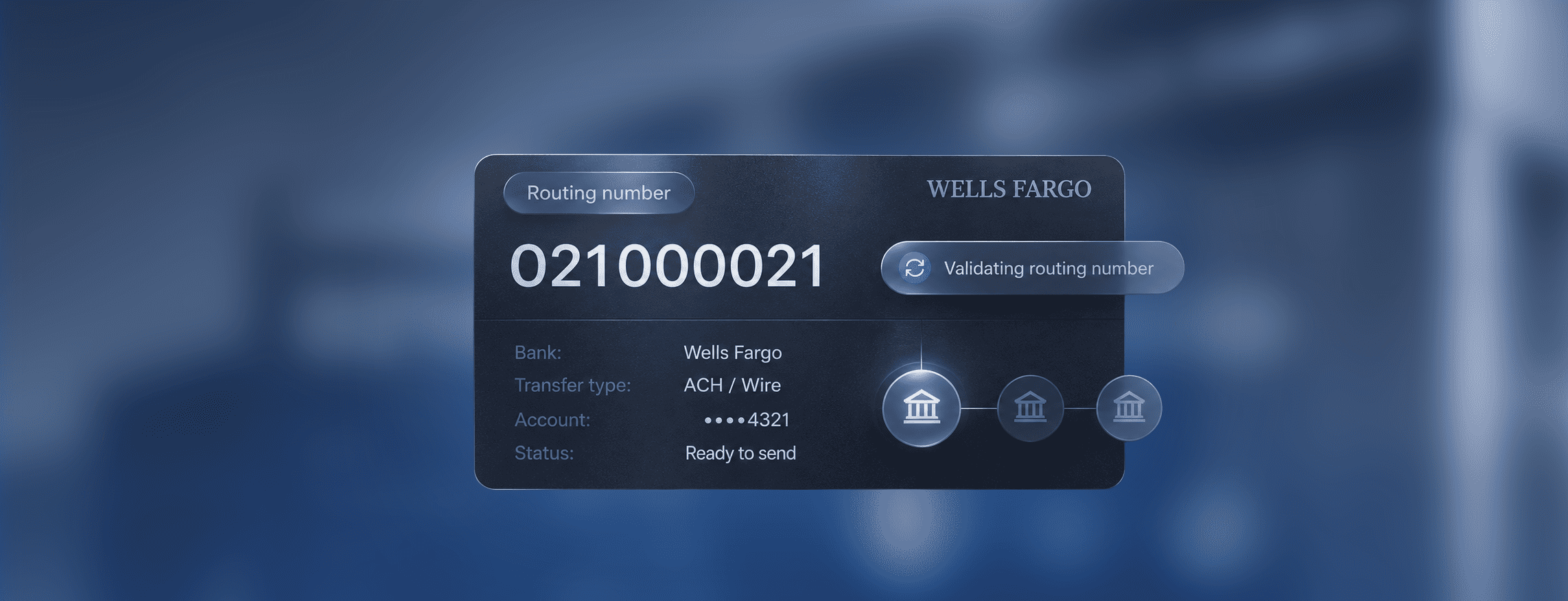
For example, consider this illustrative routing number: 021000021

The nine digits are divided into three sections:

Section Example Purpose
First four digits 0210 Identify the Federal Reserve routing symbol and processing centre
Next four digits 0002 Identify the financial institution
Final digit 1 Serves as the check digit used to validate the routing number

‍

Here's a closer look at each section:

  1. Federal Reserve routing symbol: The first four digits identify the Federal Reserve district and processing centre associated with the financial institution.
  2. ABA institution identifier: The next four digits identify the specific financial institution.
  3. Check digit: The final digit is calculated using a mathematical formula to help detect errors in the routing number.

This structure helps payment systems recognise and validate routing numbers during financial transactions.

The example above illustrates the format. Always verify the actual routing number with the relevant bank before using it for a payment.

‍

What Is an ABA Routing Number?

An ABA routing number is another name for a US bank routing number. ABA stands for the American Bankers Association, the organisation that introduced the routing number system.

You may see the following terms used interchangeably:

  • ABA routing number
  • ABA number
  • Routing number
  • Routing transit number (RTN)

They generally refer to the same nine-digit bank identifier.

The ABA routing number helps identify the financial institution involved in a payment. It is used by banks and payment networks to process transactions, including electronic transfers and cheque payments.

The American Bankers Association oversees the routing number policy framework, while LexisNexis Risk Solutions serves as the official registrar of ABA routing numbers.

‍

What Is a Routing Number Used For?

Routing numbers are used in different types of US banking transactions. They help financial institutions identify where money should be sent or collected.

Here are some common situations where you may need one.

1. Direct Deposits

A routing number is required when setting up direct deposit payments into a US bank account.

For example, an employee receiving their salary through direct deposit may need to provide their employer with their routing number and account number.

The routing number identifies the bank, while the account number directs the payment to the employee's specific account.

2. ACH Transfers

ACH stands for Automated Clearing House. It is a US electronic payment network that processes transactions between participating banks and financial institutions.

Routing numbers help identify the banks involved in ACH payments.

Common examples include:

  • Sending money between bank accounts.
  • Receiving salary payments.
  • Paying monthly bills.
  • Setting up recurring subscriptions.
  • Making automatic loan repayments.

3. Domestic Wire Transfers

A routing number may also be required when sending or receiving a domestic wire transfer within the United States.

However, some banks use a different routing number for wire transfers than they use for ACH payments.

Before initiating a wire transfer, confirm the correct number with your bank or the recipient's financial institution.

4. Automatic Bill Payments

Companies that collect recurring payments from US bank accounts may request a routing number and account number to set up automatic withdrawals.

For example, you may need these details when arranging recurring payments for utilities, insurance, rent or loan repayments.

5. Cheque Processing

Routing numbers were originally created to support cheque processing.

When a cheque is deposited or processed, the routing number helps identify the financial institution responsible for the payment.

Although electronic payments are now widely used, routing numbers remain an important part of the US banking system.

‍

How to Find a Routing Number

There are several ways to find your bank's routing number. You don't necessarily need a physical cheque because many banks provide this information through their mobile apps and online banking platforms.

Here are four ways to find it.

1. Check the Bottom of Your Cheque

If you have a US cheque book, you can usually find your routing number printed along the bottom edge.

The numbers are arranged in a specific order:

  • The first nine-digit number is the routing number.
  • The next set of digits is your bank account number.
  • The final digits usually represent the cheque number.

For example: 021000021 | 123456789012 | 1001

In this illustrative example:

  • 021000021 is the routing number.
  • 123456789012 is the account number.
  • 1001 is the cheque number.

The exact formatting may vary, but the routing number is generally the first nine-digit group on the left.

2. Check Your Mobile Banking App

Most US banks allow customers to view their routing number through their mobile banking apps.

The steps may differ depending on the bank, but you can usually find it by:

  1. Opening your bank's mobile app.
  2. Signing in to your account.
  3. Selecting the relevant bank account.
  4. Opening the account details or account information section.
  5. Looking for the routing number.

Some banking apps also allow you to copy your routing and account numbers directly.

3. Use Online Banking

You can also find your routing number by logging in to your bank's official website.

Look for sections labelled:

  • Account details.
  • Account information.
  • Direct deposit information.
  • Routing and account numbers.

If your bank operates in several states, make sure you select the correct account because different regions may use different routing numbers.

4. Contact Your Bank

If you cannot find your routing number, contact your bank through its official customer service channels.

This is particularly important if you're setting up a wire transfer or an international payment, as you may need a specific routing number for that transaction.

‍

                Send money with Pesa

‍

What Is the Difference Between a Routing Number and an Account Number?

A routing number and an account number are both used in US banking transactions, but they identify different things.

A routing number identifies the financial institution, while an account number identifies the specific bank account receiving or sending the money.

Here's how they compare:

Feature Routing Number Account Number
Purpose Identifies the financial institution Identifies an individual bank account
Length 9 digits Varies by bank
Assigned to Eligible financial institution Individual bank account
Used for Direct deposits, ACH payments, wire transfers and cheques Identifying the account involved in a transaction
Uniqueness May be shared by many customers of the same bank Unique to the specific account within the bank

For example, if someone wants to send money to your US bank account, they may need both details.

The routing number directs the payment to your bank, while the account number helps identify your particular account.

‍

Routing Number vs SWIFT Code vs IBAN

Routing numbers, SWIFT codes and IBANs are all used to identify banks or accounts during financial transactions. However, they serve different purposes and are used in different banking systems.

Feature Routing Number SWIFT/BIC Code IBAN
Main purpose Identifies a US financial institution Identifies a financial institution Identifies a specific bank account
Format 9 digits 8 or 11 alphanumeric characters Varies by country, up to 34 characters
Main usage US domestic payments International financial messaging and payments Account identification in countries using IBAN
Commonly used in United States International banking Europe and other IBAN-participating countries

For example, if you're sending money to a US bank account, you may need the recipient's routing number and account number.

If you're sending money to a bank in the UK or another country, you may instead be asked for a SWIFT/BIC code and an IBAN or local account details.

The exact information required depends on the destination country, receiving bank and payment method.

‍

Is a Routing Number the Same as a UK Sort Code?

No. A US routing number and a UK sort code perform similar functions, but they belong to different banking systems.

A routing number is a nine-digit code used to identify financial institutions in the United States.

A UK sort code is a six-digit number used to identify a bank and branch or processing location within the UK banking system.

Here's a quick comparison:

Feature US Routing Number UK Sort Code
Country United States United Kingdom
Length 9 digits 6 digits
Main purpose Identifies a US financial institution Identifies a UK bank and branch or processing location
Common usage ACH payments, direct deposits and domestic wires UK domestic bank transfers and direct debits

If you're receiving money from a US bank account, you may be asked for a routing number. If you're receiving a domestic UK bank transfer, the sender may need your sort code and account number instead.

‍

Are There Different Types of Routing Numbers?

Yes. Some US banks use different routing numbers depending on the type of transaction being processed.

The most common distinctions are:

1. ACH Routing Number

An ACH routing number is used for electronic payments processed through the Automated Clearing House network.

Examples include direct deposits, recurring bill payments and transfers between bank accounts.

2. Wire Transfer Routing Number

A wire transfer routing number is used for domestic wire transfers through the relevant US payment system.

Some banks use a different routing number for wire transfers than they use for ACH transactions.

3. Regional Routing Numbers

Some large banks have multiple routing numbers associated with different states, regions or account-opening locations.

This means that two customers using the same bank may have different routing numbers depending on where their accounts were opened or the type of transaction involved.

Important: Do not assume that the routing number printed on your cheque is the correct one for every transaction. Always confirm whether the recipient or payment provider needs an ACH, wire or another specific routing number.

‍

‍

Do You Need a Routing Number for International Transfers?

It depends on where the money is going and how the transfer is processed.

Routing numbers are primarily used within the US banking system. If you're sending money to a bank account in another country, you will generally need the recipient's international or local banking details instead.

For example:

  • Sending money to the US: The recipient may need to provide a routing number and account number for a domestic US payment or US bank deposit.
  • Sending money to the UK: You may need a sort code and account number, or an IBAN and SWIFT/BIC code, depending on the payment method.
  • Sending money to Europe: The recipient may need to provide an IBAN and, where required, a SWIFT/BIC code.
  • Sending money to Nigeria: You may need the recipient's bank name, account number and other details requested by the payment provider.

There are exceptions. Some international wire transfers involving US banks may require a US routing number alongside a SWIFT/BIC code or intermediary bank details.

Always follow the exact instructions provided by your bank or money transfer service.

‍

Can a Bank Have More Than One Routing Number?

Yes. Some banks have multiple routing numbers.

This is common among large financial institutions that operate across several US states or process different types of payments.

A bank may have separate routing numbers for:

  • Different states or regions.
  • ACH transactions.
  • Domestic wire transfers.
  • Specific account types.
  • Certain payment-processing arrangements.

For this reason, you should not assume that every customer of the same bank uses an identical routing number.

Check your bank's official website or contact its customer support team to confirm the correct number for your account and transaction.

‍

Frequently Asked Questions

1. How many digits are in a routing number?

A standard US routing number contains nine digits. The number identifies the financial institution and includes a final check digit used to validate the code.

2. Is a routing number the same as an ABA number?

Yes. ABA routing number, ABA number and routing transit number are commonly used names for the same nine-digit identifier in the United States.

3. Can I find my routing number without a cheque?

Yes. You can usually find it through your bank's mobile app, online banking platform or official website. You can also contact your bank directly.

4. Is it safe to share my routing number?

Routing numbers are commonly shared for legitimate banking transactions, such as setting up direct deposits or receiving payments. However, be careful when sharing your routing and account numbers together. Only provide them to trusted organisations through verified channels, and never share your banking password, PIN or one-time passcodes.

5. Does my routing number change?

It can. Banks may change or replace routing numbers following mergers, acquisitions, operational changes or other banking arrangements. Some banks also use different routing numbers for different transaction types.

Always check with your bank before using an old routing number.

6. Can I use my routing number to receive money from another country?

Sometimes. A US routing number may be required when an international payment provider sends money to your US bank account through a US-based payment route. However, the sender may also need other information, such as your account number, SWIFT/BIC code or intermediary bank details.

Follow the receiving bank's instructions to ensure you provide the correct information.

‍

Conclusion

A routing number is a nine-digit code that identifies a financial institution in the United States. It plays an important role in processing domestic bank transfers, direct deposits, ACH payments, wire transfers and cheque transactions.

You can usually find your routing number on the bottom of a cheque, through your bank's mobile app or by logging in to online banking.

Before using it, make sure you have the correct number for the transaction. Some banks use different routing numbers for ACH payments and wire transfers, so confirming the details with your bank can help prevent payment delays and errors.

‍

                Send money with Pesa

Adeniyi

Related articles

See all
Adeniyi
Ibukun
Felix
Oge
Tolu Osho

Ready to
Experience Pesa?

Think money
‍Think Pesa

From home to abroad, and everywhere in between. We’ll help you send, receive, and convert your money with ease.

Download the appDownload the app

© 2026 Pesa LLC. All rights reserved.

Pesapeer Inc, is registered and regularised in Canada by the Financial Transactions and Report Analysis Centre of Canada as a Money Service Business. Rn: M20300281.

Pesapeer Payments LLC ((NMLS number 2796311) is registered in the United States as a Money Service Business with the United States Financial Crimes Enforcement Network (FinCEN). Rn: 31000315905794.

Pesapeer Payments Limited. Authorised and regulated by the Financial Conduct Authority (FCA) as Electronic Money Institution under Firm Reference Number (FRN) 931425. Registered address: Milton Hall Ely Road, Milton, Cambridge, England, CB24 6WZC UNITED KINGDOM.

Pesapeer Pty Ltd is also registered and regularised in Australia by the Australian Transaction Reports and Analysis Centre as an Independent Remittance Dealer  Rn: IND100859468-001

Back

What Is a Routing Number? Everything You Need to Know

By
Adeniyi
.
November 25, 2026
.
3
mins read
Money Matters

A routing number is a nine-digit code used to identify a bank or financial institution in the United States. It helps banks and payment networks direct money to the correct financial institution when processing transactions such as direct deposits, electronic payments, wire transfers and cheque payments.

You may be asked for a routing number when receiving money from a US bank account, setting up an automatic bill payment or arranging a domestic bank transfer. It is usually provided alongside your bank account number, which identifies your specific account.

Routing numbers are also known as ABA routing numbers or routing transit numbers (RTNs). Although they serve a similar purpose to bank identification codes in other countries, they are specific to the US banking system.

In this guide, we'll explain what a routing number is, how it works, where to find yours and when you need one for domestic or international transfers.

Key Takeaways

  • A US bank routing number is a nine-digit code that identifies a financial institution.
  • It is also called an ABA routing number or routing transit number (RTN).
  • Routing numbers are used for ACH payments, direct deposits, domestic wire transfers and cheque processing.
  • You can find your routing number on a cheque, in your bank's mobile app or through online banking.
  • Some banks have different routing numbers for ACH payments and wire transfers, so always confirm which one you need.

‍

What Is a Bank Routing Number?

A bank routing number is a unique nine-digit identifier assigned to an eligible financial institution in the United States. It helps payment networks identify the bank responsible for sending or receiving a payment.

The system was introduced by the American Bankers Association (ABA) in 1910 to make cheque processing more efficient. Although it was originally developed for paper cheques, routing numbers are now used for various electronic payment services.

For example, if an employer in the United States wants to pay an employee through direct deposit, the employee may need to provide their bank's routing number and personal account number.

The routing number identifies the bank, while the account number identifies the employee's specific account within that bank.

A routing number is therefore an important part of US banking transactions. Without the correct number, a payment may be delayed, rejected or sent to the wrong financial institution.

‍

                Download the Pesa app

‍

What Does a Routing Number Look Like?

A standard US routing number contains nine digits. Each digit has a specific role in identifying the financial institution and validating the number.

For example, consider this illustrative routing number: 021000021

The nine digits are divided into three sections:

Section Example Purpose
First four digits 0210 Identify the Federal Reserve routing symbol and processing centre
Next four digits 0002 Identify the financial institution
Final digit 1 Serves as the check digit used to validate the routing number

‍

Here's a closer look at each section:

  1. Federal Reserve routing symbol: The first four digits identify the Federal Reserve district and processing centre associated with the financial institution.
  2. ABA institution identifier: The next four digits identify the specific financial institution.
  3. Check digit: The final digit is calculated using a mathematical formula to help detect errors in the routing number.

This structure helps payment systems recognise and validate routing numbers during financial transactions.

The example above illustrates the format. Always verify the actual routing number with the relevant bank before using it for a payment.

‍

What Is an ABA Routing Number?

An ABA routing number is another name for a US bank routing number. ABA stands for the American Bankers Association, the organisation that introduced the routing number system.

You may see the following terms used interchangeably:

  • ABA routing number
  • ABA number
  • Routing number
  • Routing transit number (RTN)

They generally refer to the same nine-digit bank identifier.

The ABA routing number helps identify the financial institution involved in a payment. It is used by banks and payment networks to process transactions, including electronic transfers and cheque payments.

The American Bankers Association oversees the routing number policy framework, while LexisNexis Risk Solutions serves as the official registrar of ABA routing numbers.

‍

What Is a Routing Number Used For?

Routing numbers are used in different types of US banking transactions. They help financial institutions identify where money should be sent or collected.

Here are some common situations where you may need one.

1. Direct Deposits

A routing number is required when setting up direct deposit payments into a US bank account.

For example, an employee receiving their salary through direct deposit may need to provide their employer with their routing number and account number.

The routing number identifies the bank, while the account number directs the payment to the employee's specific account.

2. ACH Transfers

ACH stands for Automated Clearing House. It is a US electronic payment network that processes transactions between participating banks and financial institutions.

Routing numbers help identify the banks involved in ACH payments.

Common examples include:

  • Sending money between bank accounts.
  • Receiving salary payments.
  • Paying monthly bills.
  • Setting up recurring subscriptions.
  • Making automatic loan repayments.

3. Domestic Wire Transfers

A routing number may also be required when sending or receiving a domestic wire transfer within the United States.

However, some banks use a different routing number for wire transfers than they use for ACH payments.

Before initiating a wire transfer, confirm the correct number with your bank or the recipient's financial institution.

4. Automatic Bill Payments

Companies that collect recurring payments from US bank accounts may request a routing number and account number to set up automatic withdrawals.

For example, you may need these details when arranging recurring payments for utilities, insurance, rent or loan repayments.

5. Cheque Processing

Routing numbers were originally created to support cheque processing.

When a cheque is deposited or processed, the routing number helps identify the financial institution responsible for the payment.

Although electronic payments are now widely used, routing numbers remain an important part of the US banking system.

‍

How to Find a Routing Number

There are several ways to find your bank's routing number. You don't necessarily need a physical cheque because many banks provide this information through their mobile apps and online banking platforms.

Here are four ways to find it.

1. Check the Bottom of Your Cheque

If you have a US cheque book, you can usually find your routing number printed along the bottom edge.

The numbers are arranged in a specific order:

  • The first nine-digit number is the routing number.
  • The next set of digits is your bank account number.
  • The final digits usually represent the cheque number.

For example: 021000021 | 123456789012 | 1001

In this illustrative example:

  • 021000021 is the routing number.
  • 123456789012 is the account number.
  • 1001 is the cheque number.

The exact formatting may vary, but the routing number is generally the first nine-digit group on the left.

2. Check Your Mobile Banking App

Most US banks allow customers to view their routing number through their mobile banking apps.

The steps may differ depending on the bank, but you can usually find it by:

  1. Opening your bank's mobile app.
  2. Signing in to your account.
  3. Selecting the relevant bank account.
  4. Opening the account details or account information section.
  5. Looking for the routing number.

Some banking apps also allow you to copy your routing and account numbers directly.

3. Use Online Banking

You can also find your routing number by logging in to your bank's official website.

Look for sections labelled:

  • Account details.
  • Account information.
  • Direct deposit information.
  • Routing and account numbers.

If your bank operates in several states, make sure you select the correct account because different regions may use different routing numbers.

4. Contact Your Bank

If you cannot find your routing number, contact your bank through its official customer service channels.

This is particularly important if you're setting up a wire transfer or an international payment, as you may need a specific routing number for that transaction.

‍

                Send money with Pesa

‍

What Is the Difference Between a Routing Number and an Account Number?

A routing number and an account number are both used in US banking transactions, but they identify different things.

A routing number identifies the financial institution, while an account number identifies the specific bank account receiving or sending the money.

Here's how they compare:

Feature Routing Number Account Number
Purpose Identifies the financial institution Identifies an individual bank account
Length 9 digits Varies by bank
Assigned to Eligible financial institution Individual bank account
Used for Direct deposits, ACH payments, wire transfers and cheques Identifying the account involved in a transaction
Uniqueness May be shared by many customers of the same bank Unique to the specific account within the bank

For example, if someone wants to send money to your US bank account, they may need both details.

The routing number directs the payment to your bank, while the account number helps identify your particular account.

‍

Routing Number vs SWIFT Code vs IBAN

Routing numbers, SWIFT codes and IBANs are all used to identify banks or accounts during financial transactions. However, they serve different purposes and are used in different banking systems.

Feature Routing Number SWIFT/BIC Code IBAN
Main purpose Identifies a US financial institution Identifies a financial institution Identifies a specific bank account
Format 9 digits 8 or 11 alphanumeric characters Varies by country, up to 34 characters
Main usage US domestic payments International financial messaging and payments Account identification in countries using IBAN
Commonly used in United States International banking Europe and other IBAN-participating countries

For example, if you're sending money to a US bank account, you may need the recipient's routing number and account number.

If you're sending money to a bank in the UK or another country, you may instead be asked for a SWIFT/BIC code and an IBAN or local account details.

The exact information required depends on the destination country, receiving bank and payment method.

‍

Is a Routing Number the Same as a UK Sort Code?

No. A US routing number and a UK sort code perform similar functions, but they belong to different banking systems.

A routing number is a nine-digit code used to identify financial institutions in the United States.

A UK sort code is a six-digit number used to identify a bank and branch or processing location within the UK banking system.

Here's a quick comparison:

Feature US Routing Number UK Sort Code
Country United States United Kingdom
Length 9 digits 6 digits
Main purpose Identifies a US financial institution Identifies a UK bank and branch or processing location
Common usage ACH payments, direct deposits and domestic wires UK domestic bank transfers and direct debits

If you're receiving money from a US bank account, you may be asked for a routing number. If you're receiving a domestic UK bank transfer, the sender may need your sort code and account number instead.

‍

Are There Different Types of Routing Numbers?

Yes. Some US banks use different routing numbers depending on the type of transaction being processed.

The most common distinctions are:

1. ACH Routing Number

An ACH routing number is used for electronic payments processed through the Automated Clearing House network.

Examples include direct deposits, recurring bill payments and transfers between bank accounts.

2. Wire Transfer Routing Number

A wire transfer routing number is used for domestic wire transfers through the relevant US payment system.

Some banks use a different routing number for wire transfers than they use for ACH transactions.

3. Regional Routing Numbers

Some large banks have multiple routing numbers associated with different states, regions or account-opening locations.

This means that two customers using the same bank may have different routing numbers depending on where their accounts were opened or the type of transaction involved.

Important: Do not assume that the routing number printed on your cheque is the correct one for every transaction. Always confirm whether the recipient or payment provider needs an ACH, wire or another specific routing number.

‍

‍

Do You Need a Routing Number for International Transfers?

It depends on where the money is going and how the transfer is processed.

Routing numbers are primarily used within the US banking system. If you're sending money to a bank account in another country, you will generally need the recipient's international or local banking details instead.

For example:

  • Sending money to the US: The recipient may need to provide a routing number and account number for a domestic US payment or US bank deposit.
  • Sending money to the UK: You may need a sort code and account number, or an IBAN and SWIFT/BIC code, depending on the payment method.
  • Sending money to Europe: The recipient may need to provide an IBAN and, where required, a SWIFT/BIC code.
  • Sending money to Nigeria: You may need the recipient's bank name, account number and other details requested by the payment provider.

There are exceptions. Some international wire transfers involving US banks may require a US routing number alongside a SWIFT/BIC code or intermediary bank details.

Always follow the exact instructions provided by your bank or money transfer service.

‍

Can a Bank Have More Than One Routing Number?

Yes. Some banks have multiple routing numbers.

This is common among large financial institutions that operate across several US states or process different types of payments.

A bank may have separate routing numbers for:

  • Different states or regions.
  • ACH transactions.
  • Domestic wire transfers.
  • Specific account types.
  • Certain payment-processing arrangements.

For this reason, you should not assume that every customer of the same bank uses an identical routing number.

Check your bank's official website or contact its customer support team to confirm the correct number for your account and transaction.

‍

Frequently Asked Questions

1. How many digits are in a routing number?

A standard US routing number contains nine digits. The number identifies the financial institution and includes a final check digit used to validate the code.

2. Is a routing number the same as an ABA number?

Yes. ABA routing number, ABA number and routing transit number are commonly used names for the same nine-digit identifier in the United States.

3. Can I find my routing number without a cheque?

Yes. You can usually find it through your bank's mobile app, online banking platform or official website. You can also contact your bank directly.

4. Is it safe to share my routing number?

Routing numbers are commonly shared for legitimate banking transactions, such as setting up direct deposits or receiving payments. However, be careful when sharing your routing and account numbers together. Only provide them to trusted organisations through verified channels, and never share your banking password, PIN or one-time passcodes.

5. Does my routing number change?

It can. Banks may change or replace routing numbers following mergers, acquisitions, operational changes or other banking arrangements. Some banks also use different routing numbers for different transaction types.

Always check with your bank before using an old routing number.

6. Can I use my routing number to receive money from another country?

Sometimes. A US routing number may be required when an international payment provider sends money to your US bank account through a US-based payment route. However, the sender may also need other information, such as your account number, SWIFT/BIC code or intermediary bank details.

Follow the receiving bank's instructions to ensure you provide the correct information.

‍

Conclusion

A routing number is a nine-digit code that identifies a financial institution in the United States. It plays an important role in processing domestic bank transfers, direct deposits, ACH payments, wire transfers and cheque transactions.

You can usually find your routing number on the bottom of a cheque, through your bank's mobile app or by logging in to online banking.

Before using it, make sure you have the correct number for the transaction. Some banks use different routing numbers for ACH payments and wire transfers, so confirming the details with your bank can help prevent payment delays and errors.

‍

                Send money with Pesa

Think Money

Think Pesa

Send, spend, save and do more with Pesa
— simply and freely.
Download the app
Download the app