

.svg)


Canada does not have a single universal minimum wage. It has a federal rate plus 13 separate provincial and territorial rates, all of which update on different schedules throughout the year.
So, whether you’re coming to Canada as a student or as a permanent resident, this guide breaks down exactly what the minimum wage looks like in Canada in 2026.
How minimum wage works in Canada
Canada uses a two-tier minimum wage system. There is a federal minimum wage that applies to workers in federally regulated industries, and provincial and territorial minimum wages apply to everyone else.
The federal minimum wage applies to sectors under federal authority — banks, telecommunications companies, airlines, postal services, railways, and interprovincial transportation companies. As of April 1, 2026, the federal minimum wage is $18.15 per hour, up from $17.75. It is indexed to inflation and is adjusted annually each April.
Here is the important rule: if your province's minimum wage is higher than the federal rate, your employer must pay you the higher of the two. The federal rate is a rate, not the highest amount that can be paid.
For the vast majority of workers in retail, hospitality, healthcare support, construction, food service, education, and most other industries, your provincial or territorial minimum wage applies.
Minimum wage by province and territory in Canada
Rates vary significantly across Canada. The gap between the highest and lowest provincial minimum wages currently stands at over $4 per hour, translating to a roughly $8,000 difference in annual earnings for a full-time worker.
British Columbia — $18.25/hr BC currently has the highest minimum wage among Canadian provinces. The rate is tied to annual inflation and increases on June 1 each year. All workers, regardless of whether they earn tips, receive the same base rate. Online platform workers (ride-hailing and delivery apps) have a separate rate of $21.89/hour.
Ontario — $17.60/hr. Ontario's minimum wage is updated annually on October 1, indexed to the provincial Consumer Price Index. It is the most closely watched rate in Canada, given the province's economic size and population. The student minimum wage (for workers under 18 who work 28 hours or fewer per week during the school term) is $16.60/hour. Homeworkers, employees who perform paid work from their own homes, receive $19.35/hour.
Alberta — $15.00/hr (unchanged since 2019) Alberta has the lowest minimum wage among Canadian provinces and is the only major province without automatic inflation indexing. No increase is currently scheduled for 2026. The student rate for workers aged 13 to 17 is $13/hour for the first 28 hours per week during the school term; hours beyond 28 per week are paid at the general $15/hour rate.
Quebec — $16.60 Quebec adjusts its minimum wage annually in May. Tipped workers have a separate rate: $12.90/hour currently, rising to $13.30 on May 1, 2026. This lower rate for tipped workers reflects the expectation that gratuities will supplement earnings, though the combined amount must always meet or exceed the general minimum wage.
Nova Scotia — $16.75 on April 1, 2026, (rising to $17.00 on October 1, 2026). Nova Scotia committed to a two-step increase in 2026, ultimately landing at $17.00/hour by October — tied with PEI for the highest rate in Atlantic Canada.
Prince Edward Island — $17.00 PEI has consistently prioritized maintaining the highest minimum wage in Atlantic Canada. Full-time workers at the new rate will earn approximately $1,040 more annually before taxes.
New Brunswick — $15.90/hr. New Brunswick ties its minimum wage to the national Consumer Price Index and adjusts each April. Overtime kicks in at 44 hours per week, paid at $23.85/hour.
Newfoundland and Labrador — $16.35 Newfoundland indexes to the previous year's CPI. Increases are modest but consistent.
Manitoba — $16.00/hr. Manitoba updates annually in October. A further increase is expected in fall 2026.
Saskatchewan — $15.35/hr Saskatchewan's rate ranks among the lower provincial minimums. Updates occur each October.
Nunavut — $19.75/hr. Nunavut has the highest minimum wage in the entire country, reflecting the extreme cost of living in the territory where food, energy, and housing costs are dramatically higher than in southern Canada.
Northwest Territories — $16.95/hr. NWT adjusts annually in September using a formula based on both CPI and average wage changes.
Yukon — $17.94/hr. Yukon indexes to CPI and adjusts each April.
How your career affects your minimum wage in Canada
For most workers, the general provincial rate is what applies. But several industries and roles have specific minimum wage rules worth knowing.
Federally regulated careers — If you work at a bank, airline, telecommunications company, Canada Post, or a railway or trucking company that crosses provincial or national borders, you are covered by the federal minimum wage of $18.15/hour, regardless of which province you live in.
Tipped and service industry workers — Quebec maintains a lower minimum for workers who regularly receive gratuities. Other provinces, including BC, have eliminated this distinction and pay tipped workers the same general minimum wage. If you work in hospitality or food service outside Quebec, your base rate is the standard provincial minimum; tips are on top of that, not instead of it.
Agricultural and harvest workers — BC has specific minimum piece rates for hand-harvested crops, updated annually in December. Nova Scotia, New Brunswick, and several other provinces have specialized rates for farm workers. If you work in agriculture, check your province's employment standards specifically.
Domestic workers and caregivers — Alberta has a separate domestic worker rate of $2,848 per month for live-in domestic employees. Ontario homeworkers (those doing paid work from home, such as data entry or production work) receive a premium rate of $19.35/hour.
Wilderness and hunting/fishing guides — Ontario has special daily rates for these workers: $88.05 for a working day of fewer than five consecutive hours, and $176.15 for a full day of five or more consecutive hours.
Construction and trades apprentices — Nova Scotia has tiered apprentice rates that depend on how many cumulative hours a trainee has worked in their trade, increasing as they progress through training stages.
Gig economy and platform workers — BC has led the country in establishing a specific minimum for app-based ride-hailing and food delivery workers ($21.89/hour as of June 2026), recognizing that the flexible scheduling of gig work should not come at the cost of wage protections.
Commission-based roles — Across all provinces, even if your compensation is entirely or partly commission-based, your total earnings must average out to at least the minimum wage for every hour worked. Employers cannot legally use commission structures to pay workers below the minimum wage floor.
Is minimum wage different for full-time or part-time workers in Canada?
In Canada, minimum wage applies equally to full-time and part-time workers. There is no legal basis for paying a part-time employee less per hour than a full-time one doing the same work.
The differences between full-time and part-time work show up in other ways:
Annual earnings — A full-time worker at Ontario's current minimum wage of $17.60/hour working 40 hours per week earns approximately $36,608 before tax per year. A part-time worker at 20 hours per week earns roughly $18,304. The hourly rate remains the same; the total income is halved.
Benefits eligibility — Most employer benefits packages (extended health, dental, retirement contributions) require a minimum number of hours per week to qualify, typically 30 to 35 hours. Part-time workers below this threshold are often not eligible. This is an employer policy distinction, not a legal one — some employers extend benefits to part-time staff, but many do not.
CPP and EI contributions — Employment Insurance premiums and Canada Pension Plan contributions are deducted from all employment income, full or part-time. Part-time workers who earn above the basic threshold ($3,500 annually for CPP) and work enough hours contribute to both. This matters for EI access: to qualify for Employment Insurance benefits, you need a minimum number of insured hours worked, which varies by region. Part-time workers accumulate these hours more slowly.
Overtime rules — Most provincial overtime thresholds are based on weekly hours, not employment status. In Ontario, for example, overtime pay kicks in after 44 hours in a week, regardless of whether you are classified as full-time or part-time. A part-time worker who picks up extra shifts and crosses 44 hours in a single week is entitled to overtime pay.
Minimum wage for students in Canada
Students under 18 in Ontario — Ontario has a specific student minimum wage of $16.60/hour, which applies to workers under 18 who work 28 hours or fewer per week during the school term. Once a student under 18 works more than 28 hours in a week, they are entitled to the general minimum wage of $17.60 for those additional hours. During school holidays and summer breaks, the 28-hour cap lifts and the general minimum wage applies.
Students in Alberta — Alberta has one of Canada's most distinct student wage structures. Workers aged 13 to 17 earn $13/hour for the first 28 hours per week worked during the school year (or during school breaks), stepping up to $15/hour for hours beyond that. This is one of the few provinces with a sub-minimum wage specifically for younger students.
Students in other provinces — Most other provinces apply the general minimum wage to all workers regardless of age or student status. There is no lower student rate in BC, Quebec, Manitoba, Nova Scotia, New Brunswick, or the territories. A 17-year-old student in Vancouver earns the same $17.85/hour as a 45-year-old full-time worker.
International students — If you are an international student studying in Canada on a valid study permit, you have the same minimum wage rights as any other worker. You are entitled to at least the minimum wage for your province, with no exceptions. International students can work up to 24 hours per week off-campus during the academic term and full-time during scheduled breaks. Your employment status (student or temporary resident) does not affect your wage entitlements.
Working on campus — If you work in cafeterias, libraries, research labs, or student services- is generally considered on-campus work under provincial employment standards. You are entitled to at least the provincial minimum wage for all hours worked. Some universities pay above minimum wage for certain roles.
What Permanent residents and newcomers need to know
If you are a permanent resident, a temporary foreign worker, or a newcomer who has recently arrived in Canada, your wage rights are identical to those of Canadian citizens. Employers cannot legally pay you less because of your immigration status.
A few things worth knowing in practice:
Your province matters more than your city — Minimum wage is set at the provincial level, not by municipality. A worker in Toronto and a worker in Thunder Bay both fall under Ontario's $17.60/hour general rate. There is no separate "big city" minimum wage in Canada, which is why advocates in expensive cities like Vancouver and Toronto argue for living wages far above the legal minimum.
The living wage vs the minimum wage gap — The living wage, the hourly rate estimated to cover basic expenses without government subsidies, is significantly higher. In Metro Vancouver, the 2025 living wage is calculated at approximately $27.85/hour. In the Greater Toronto Area, it sits at around $27.20/hour. Ontario's current minimum wage covers roughly 65% of Toronto's living wage. In smaller cities and rural communities, the gap is narrower; $16/hour goes further in Sudbury than in downtown Toronto.
Your employer cannot pay you less based on where you are from — Paying newcomers or temporary residents below the minimum wage is illegal across Canada. If you believe you are being paid below the legal minimum, you can file a complaint with your provincial employment standards office. Many provinces allow anonymous complaints.
Every worker in Canada, regardless of status, has CPP and EI deducted from their paycheque once earnings cross certain thresholds. Federal and provincial income tax is also withheld.
At minimum wage, most workers will owe little to no federal income tax. They may be eligible for a refund when they file, particularly students and lower-income earners who qualify for credits like the Basic Personal Amount and the GST/HST Credit.
What minimum wage actually looks like in take-Home Pay
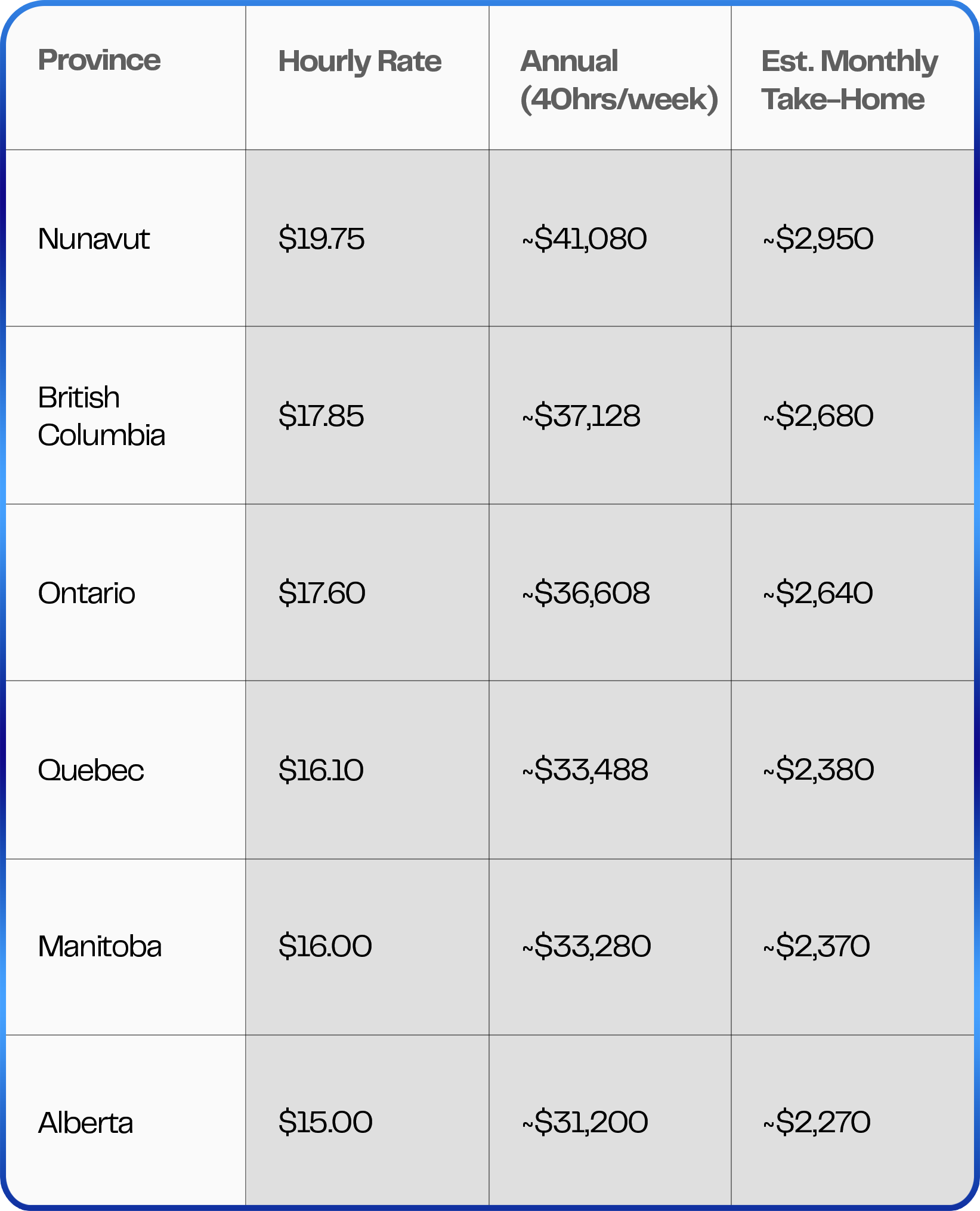
The gap between gross (before-tax) and net (after-tax) pay catches many workers off guard. Here is a rough illustration for a full-time worker in 2026:
Finally
Understanding the rate that applies to your situation, your province, your career, your employment status, and your age puts you in a far stronger position to know what you are owed, evaluate job offers, and plan your finances. Whether you are just starting your career or navigating a new country, that knowledge is worth having.
Related articles
See all




Think money
Think Pesa
From home to abroad, and everywhere in between. We’ll help you send, receive, and convert your money with ease.
Download the appDownload the app


Join thousands of users sending money
Scan the QR code below with your phone
and you’ll get a link to get started

