

.svg)


The FIFA World Cup is one of the greatest sporting events on the planet, and in 2026, it will span three countries simultaneously. With matches spread across the United States, Canada, and Mexico, many fans will be crossing borders multiple times to follow their teams. That means navigating different currencies, banking systems, and payment rules in the same trip. If you're planning to attend, understanding how to manage your money across countries is just as important as booking your flights and tickets.
This article covers everything you need to know to spend confidently during the World Cup, from currency exchange strategies to card fees, digital wallets, and country-specific cash tips.
What currencies might you need during the World Cup?
The three host nations use different currencies: the United States Dollar (USD), the Canadian Dollar (CAD), and the Mexican Peso (MXN). While these currencies are geographically close, their exchange rates, purchasing power, and acceptance vary significantly.
In the United States, card payments are near-universal, and cash is rarely essential. In Canada, the experience is similar; contactless and chip-and-pin card payments dominate. Mexico is a more mixed economy. While major cities like Mexico City and Guadalajara have broadly embraced digital payments, smaller venues, street markets, and transport services often operate on a cash-first basis. Planning for all three environments means carrying a layered payment strategy rather than relying on a single method.
The real cost of spending abroad
It is very important to understand the hidden costs that erode your travel budget when spending internationally. While many travellers and fans focus on things like accommodation and tickets, they underestimate what they lose to fees.
Foreign transaction fees
Many standard debit and credit cards charge a foreign transaction fee of 1.5% to 3% on every purchase made in a foreign currency. Across a two-week trip involving hundreds of transactions, these fees add up quickly.
Dynamic currency conversion (DCC)
When a merchant or ATM offers to process a transaction in your home currency rather than the local currency, that's dynamic currency conversion, and it almost always comes with a poor exchange rate built in. Always choose to pay in the local currency and let your own bank handle the conversion.
ATM withdrawal fees
International ATM withdrawals often carry two layers of fees: one from your home bank and one from the foreign ATM operator. These can range from $3 to $10 per withdrawal, making frequent small withdrawals expensive.
Choosing the right cards/multi-currency accounts for a multi-country World Cup trip
The single most impactful financial decision you can make before departure is to ensure you have the right card, or combination of cards, for international travel.
Travel credit cards with no foreign transaction fees
Many travel-focused credit cards waive foreign transaction fees entirely. If you don't already have one, it's worth applying before your trip. Look for cards that also offer travel protections, lounge access, and rewards on dining and transportation purchases, all of which are relevant spending categories during a World Cup trip.
Multi-Currency debit cards/ apps
Fintech solutions like Pesa, Wise, Revolut, and similar multi-currency accounts that allow you to hold USD, CAD, and MXN simultaneously and convert funds at real mid-market exchange rates. These are particularly useful for the 2026 World Cup given the multi-country format. You can top up each currency when rates are favourable and spend directly in that currency without conversion fees.

Backup cards
Always travel with at least two separate payment cards from different card networks (e.g., Visa and Mastercard) and stored in different locations. Cards can be lost, stolen, or frozen by fraud detection systems when you travel; having a backup prevents a financial emergency from ruining your trip.
How much cash to travel with and when
Even in an increasingly cashless world, having local currency on hand is a practical necessity for World Cup travel, especially in Mexico.
United States
Cash is rarely necessary at official World Cup venues, which will have modern payment infrastructure in place. However, it's worth having a small amount (USD 50–100) for tips, street food, and situations where card systems are down. U.S. venues will be card-dominant.
Canada
Similar to the U.S., Canada is a highly card-friendly environment. CAD 50–100 in cash is sufficient for most travellers as a backup. Canadian ATMs are widely available and reliable.
Mexico
Mexico warrants a more substantial cash reserve. Aim to have MXN 500–1,500 readily accessible depending on your planned activities. Street tacos, local transport (including many taxi services), smaller restaurants near stadiums, and market shopping all favour or require cash. Withdraw Pesos from bank-affiliated ATMs inside banks or supermarkets rather than standalone street ATMs, which carry higher fees and occasional fraud risk.
Where you should exchange currency: best and worst options
Currency exchange options are not created equal. Knowing which to use and which to avoid can save you a meaningful amount over the course of a long trip.
Best Options
• Your bank or credit union before departure, especially if they offer preferential rates for account holders
• Multi-currency account (Pesa, Wise, Revolut) loaded with local currency at mid-market rates
• ATMs affiliated with major local banks at your destination
• Local bank branches in your destination country
Options to Avoid
• Airport currency exchange kiosks, which typically offer rates 10–15% worse than mid-market
• Hotel front desks
• Tourist-area exchange booths with signs advertising "no commission" — the poor rate is the commission
• Dynamic currency conversion at point of sale
Digital wallets and contactless payments
Apple Pay, Google Pay, and Samsung Pay are accepted at most modern stadium and retail environments in all three 2026 host countries. If your card is already set up in a digital wallet, using contactless payment is not only faster but also more secure than swiping or inserting a physical card, because your card details are never transmitted directly during the transaction.
In Mexico, local apps like CoDi (a government-backed payment platform) and Clip are increasingly used by vendors. While these are primarily for holders of Mexican bank accounts, their widespread adoption means that merchants in Mexican host cities are generally payment-tech-savvy.
Let your local bank know you’re travelling.
One of the most common travel finance mistakes is failing to notify your bank before crossing borders. Unusual spending patterns, particularly purchases in multiple foreign countries in quick succession, can trigger automatic fraud alerts that freeze your card without warning.
Contact your bank before departure to inform them of your travel dates and the countries you'll be visiting. Many banks now allow you to set travel notifications directly within their mobile apps. Do this for every card you plan to use.
Budget across multiple currencies
Tracking your spending across USD, CAD, and MXN can quickly become confusing. A few practical approaches help:
• Use a travel budgeting app that supports multiple currencies and automatically converts spending to your home currency
• Keep a simple daily spending log in notes, recording the local amount spent and the category
• Set a daily cash-out limit for Mexico in Pesos and treat it as your daily allowance for cash expenses
• Use your bank or card app's transaction notifications to monitor spending in real time
.png)
Safety and security when handling money abroad
Travelling with cash across multiple countries raises security considerations that warrant direct attention.
• Use a money belt or hidden travel wallet for large cash amounts rather than keeping everything in a single accessible pocket or bag
• Divide your cash and cards across multiple locations: your main bag, a day bag, and a secure pocket, so a theft doesn't wipe out everything
• Be aware of your surroundings at ATMs, particularly in busy areas near stadiums
• Photograph the front and back of all your cards before travelling and store the images securely in case of loss or theft
• Know the international number for your card's lost/stolen reporting line — not the domestic number, which may not work abroad
Remember
Managing money across three countries during the World Cup doesn't have to be stressful. With the right card setup, a sensible cash strategy, and a basic awareness of fees and exchange rate pitfalls, you can focus your energy on the football rather than the finances.
The key moves are simple: get a no-foreign-transaction-fee card before you go, load a multi-currency account with USD, CAD, and MXN, carry adequate local cash in Mexico, always pay in local currency, and notify your bank before departure. Get those foundations right, and the rest takes care of itself.
Related articles
See all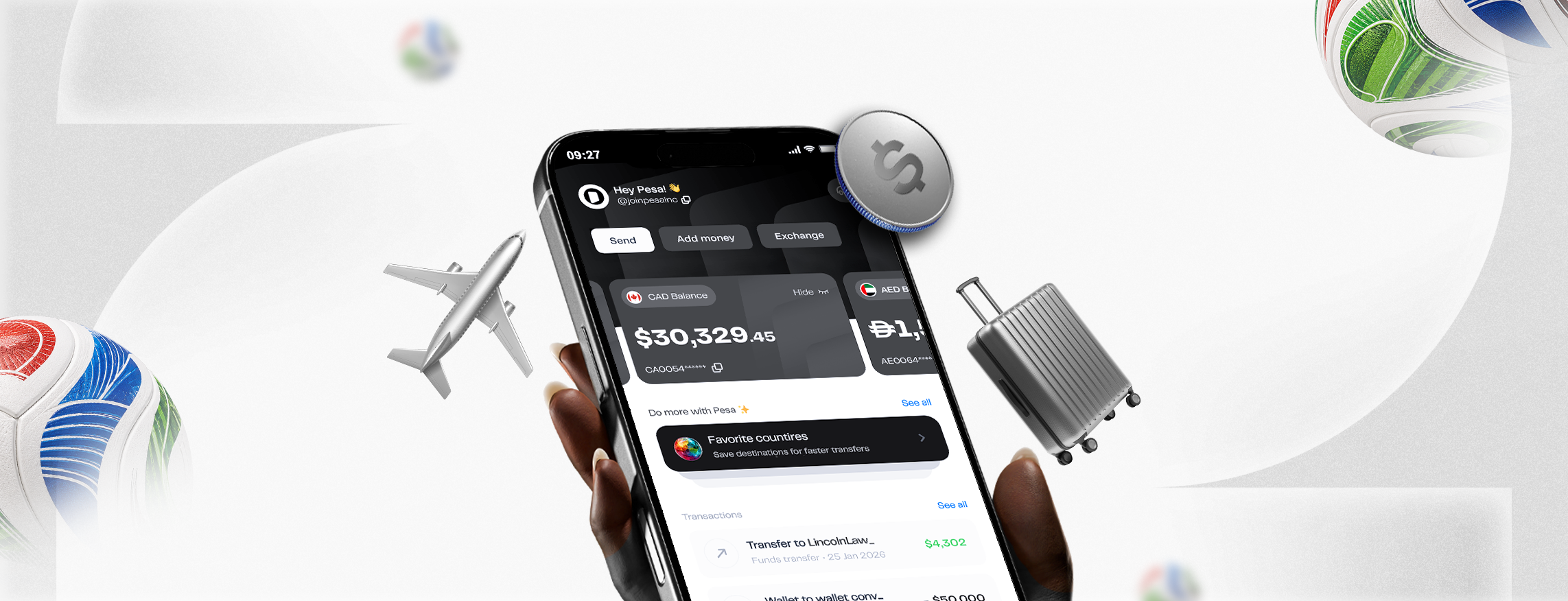
.png)


Think money
Think Pesa
From home to abroad, and everywhere in between. We’ll help you send, receive, and convert your money with ease.
Download the appDownload the app


Join thousands of users sending money
Scan the QR code below with your phone
and you’ll get a link to get started

